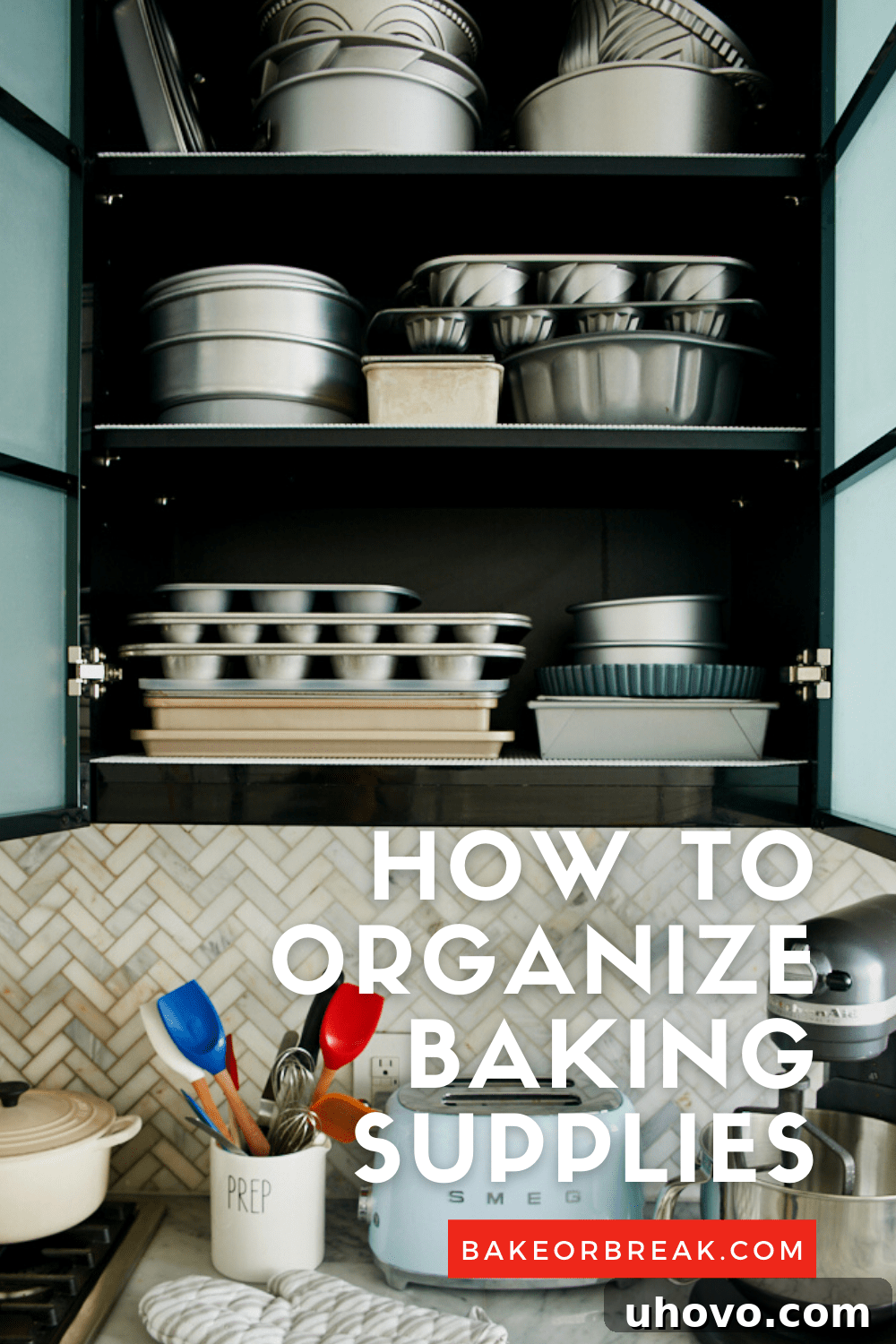
Transform your kitchen into an organized baking haven and unlock a world of culinary efficiency and joy. Say goodbye to cluttered cabinets and frustrating searches; these expert tips will guide you in organizing baking supplies to make every baking session as smooth and enjoyable as possible!
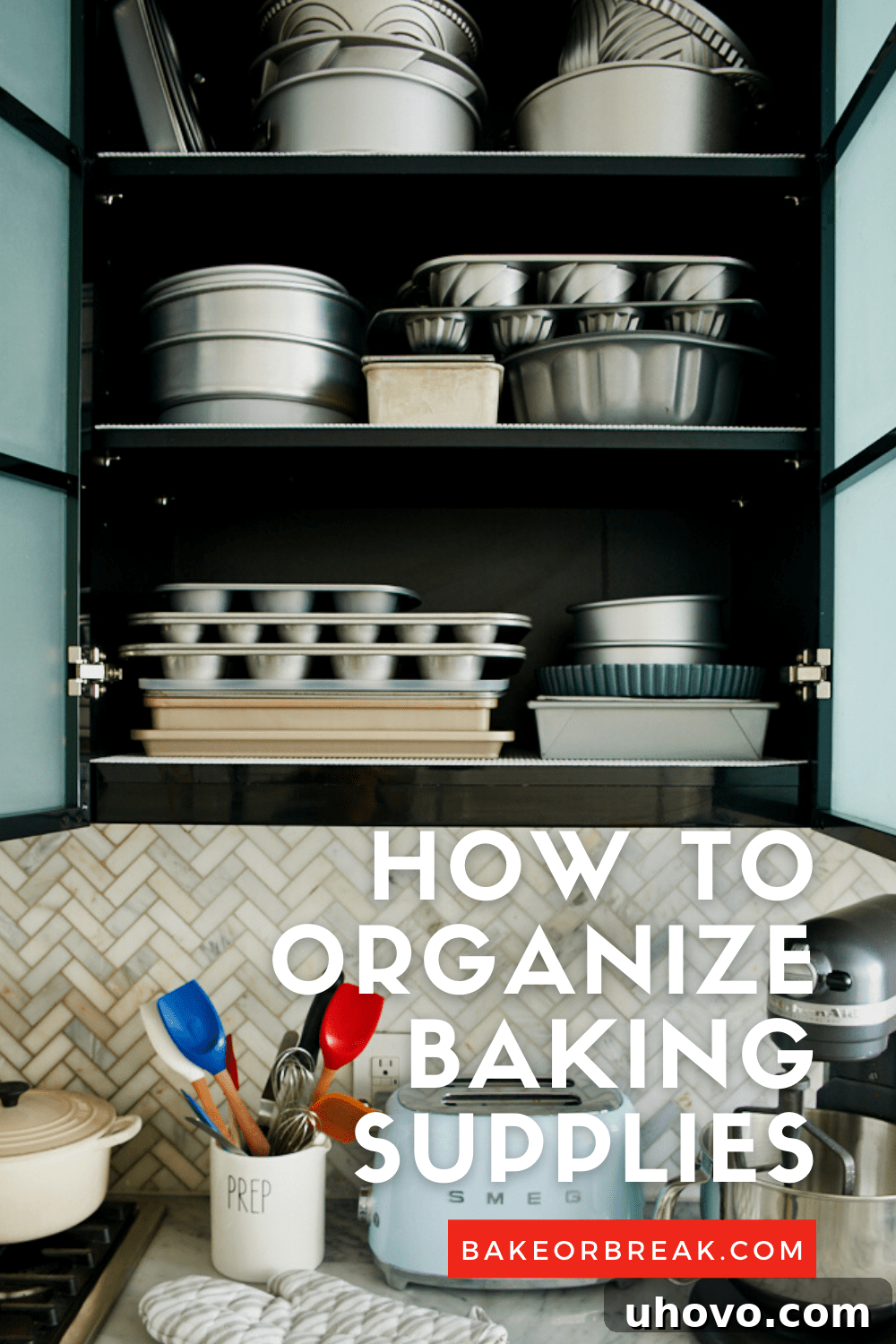
Mastering Your Baking Space: The Ultimate Guide to Organizing Baking Supplies
As a passionate baker, I’ve experienced kitchens of all shapes and sizes – from a cozy 600-square-foot apartment to a sprawling 4000-square-foot home. Currently, my Brooklyn apartment offers about 1000 square feet, featuring a wonderfully spacious kitchen. Regardless of where I’ve lived, one task I’ve always found immensely satisfying is organizing our kitchen, particularly the baking zone.
Naturally, my kitchen tends to house a more extensive collection of baking essentials than the average household. Through years of trial and error, I’ve developed organizing methods that prove effective in any kitchen size. Along this journey, I’ve also discovered innovative ways to arrange items to perfectly fit unique spaces and individual baking habits.
Whether you’re embarking on a complete baking supply overhaul, decluttering your current setup, or moving into a new home, these comprehensive tips are designed to help you maximize your baking space. Prepare to streamline your process, reduce stress, and elevate your baking experience. Let’s dive into creating the most efficient and enjoyable baking environment!
Step 1: Develop a Strategic Organization Plan
Before you lift a single item, the foundation of successful organization is a well-thought-out plan. This doesn’t need to be your final blueprint, but a clear starting point is crucial. Begin by reflecting on your current kitchen setup.
Consider what aspects currently work well and, more importantly, what challenges you face. Does your existing organization hinder your baking flow? Do you find yourself rummaging through countless items just to locate a specific ingredient like chocolate chips? Are your baking essentials frustratingly scattered across multiple cabinets and drawers?
Jot down any observations or ideas that come to mind. This could be a list of new storage items you anticipate needing, or a detailed sketch of desired improvements. Keep your personal baking priorities at the forefront – accessibility for frequently used items, logical grouping, and overall ease of use. This initial plan will serve as a vital reference point as you assess your inventory and determine your storage needs.
One of the most effective techniques for visualizing your new layout is to employ sticky notes. Label each note with an item or category you need to store: mixing bowls, measuring spoons, dry ingredients, specialty pans, extracts, etc. Then, experiment by placing these notes on your actual cabinet doors and drawer fronts, simulating where each item might logically reside. This hands-on method allows you to easily rearrange and refine your plan until you achieve a configuration that feels intuitive and efficient. Alternatively, a simple sketch or a digital layout tool can also help you visualize the ideal placement for all your baking treasures.
Step 2: Empty and Clean Your Entire Baking Zone
This critical step often feels daunting, but it’s essential for a truly effective reorganization. While you can opt to tackle smaller sections, I highly recommend a thorough reimagining of your entire baking space. Starting with a completely empty canvas allows you to objectively evaluate everything you own and truly envision new possibilities.
First, clear your countertops and any tables you plan to use. This provides ample workspace to spread out all your items, sort them, and make informed decisions. Next, with cabinets and drawers completely empty, take the opportunity to give them a deep clean. Wipe down shelves, vacuum out crumbs, and sanitize surfaces. A sparkling clean storage area creates a fresh start and sets the stage for a beautifully organized system. This seemingly minor step significantly impacts the overall success and satisfaction of your organization project.
Step 3: Sort, Declutter, and Categorize Your Supplies
With everything removed from its original spot, the real work of sorting begins. This is your chance to be ruthless and honest about what you truly need and use. Start by identifying anything that is broken, expired, or otherwise unusable. Dispose of these items immediately.
Next, separate items for donation. This includes tools or pans that are still functional but no longer serve your baking style, or duplicates you don’t actually need. This is the moment for some tough love: Will you genuinely use that oddly shaped cookie cutter you received years ago? Or that single-purpose tool that has languished untouched at the back of a drawer for ages? If an item doesn’t bring you joy or provide practical utility, it’s time to let it go.
Once you’ve decluttered, group similar items together. Think broadly at first, then refine. Categories might include:
- Basic Dry Ingredients: All-purpose flour, granulated sugar, baking soda, baking powder.
- Specialty Dry Ingredients: Almond flour, bread flour, brown sugar, cocoa powder, cornstarch.
- Spices & Extracts: Vanilla extract, cinnamon, nutmeg, food colorings.
- Fats & Liquids: Oils, vinegars (if stored in baking area).
- Baking Pans: Cake pans, loaf pans, muffin tins, sheet pans, pie plates.
- Mixing Tools: Mixing bowls (various sizes), whisks, spatulas, wooden spoons.
- Measuring Tools: Measuring cups (dry and liquid), measuring spoons.
- Specialty Tools: Cookie scoops, pastry brushes, rolling pins, decorating tips.
- Small Appliances: Hand mixer, food processor attachments (if stored with baking).
- Liners & Wraps: Muffin liners, parchment paper, plastic wrap, foil.
- Decorating Supplies: Sprinkles, edible glitter, piping bags.
The size and specific contents of these groups will naturally vary depending on your baking frequency and repertoire. This detailed sorting process will provide a clear picture of what you have, making the next steps much easier.
Step 4: Prioritize Accessibility for Frequently Used Items
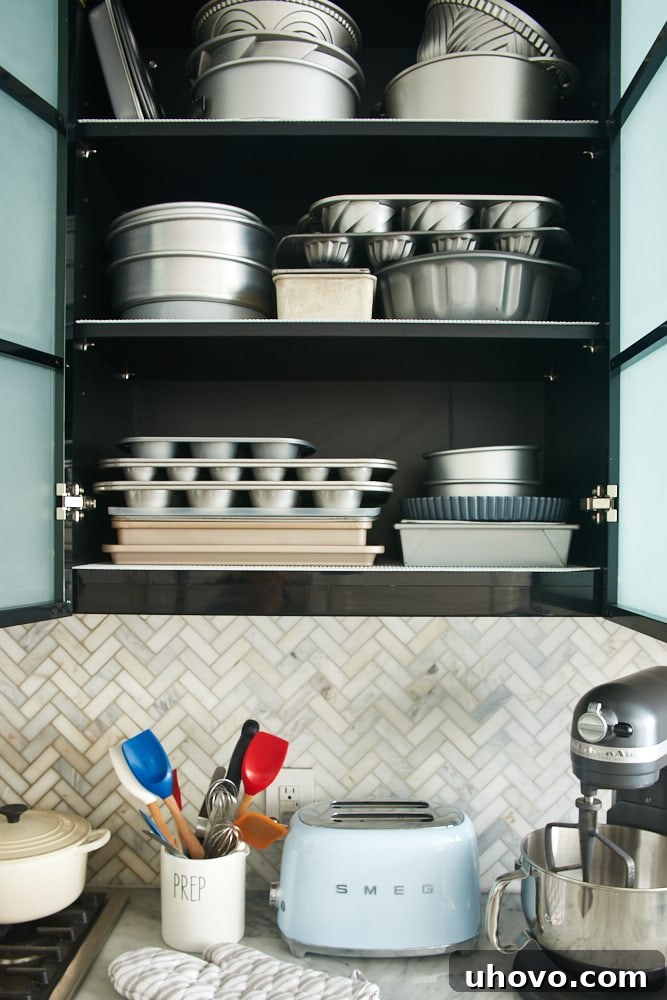
Beyond simply grouping like items, it’s crucial to consider how often you use each category. Regardless of your kitchen’s size, you’ll find much more satisfaction and efficiency if your most frequently used ingredients and tools are within easy reach. This concept is central to creating a truly functional baking space.
Designate prime real estate – eye-level shelves, easily accessible drawers, or dedicated countertop spots – for your everyday baking essentials. This means your all-purpose flour, granulated sugar, go-to mixing bowls, and favorite measuring tools should be immediately available. Items used less frequently, such as specialty flours, seasonal cookie cutters, or pans reserved for elaborate bakes, can be stored in less accessible areas, like higher cabinets, deeper pantry shelves, or even a dedicated overflow space.
Think about establishing “baking zones” within your kitchen. Perhaps one cabinet is primarily for dry ingredients, another for pans, and a specific drawer for measuring and small hand tools. This logical segmentation minimizes unnecessary movement and makes your baking process seamless. Strategic prioritization ensures that your kitchen works for you, not against you.
Step 5: Refine Your Plan and Acquire Smart Storage Solutions
It’s a common scenario: your initial organization plan, while brilliant on paper, might encounter a few practical hurdles when you start placing items. Perhaps you underestimated the space needed for your growing collection of sprinkles, or a particular cabinet isn’t as accommodating as you thought. This is perfectly normal and precisely why revisiting your plan is a vital step. Now that everything is sorted, you have a much clearer perspective on the available space and your actual needs. Spend some time reassessing, taking into account adjustable shelves that can be tailored to fit various heights of containers or stacks of pans.
This stage is also ideal for identifying and acquiring the right storage solutions that will truly optimize your space. Consider items such as:
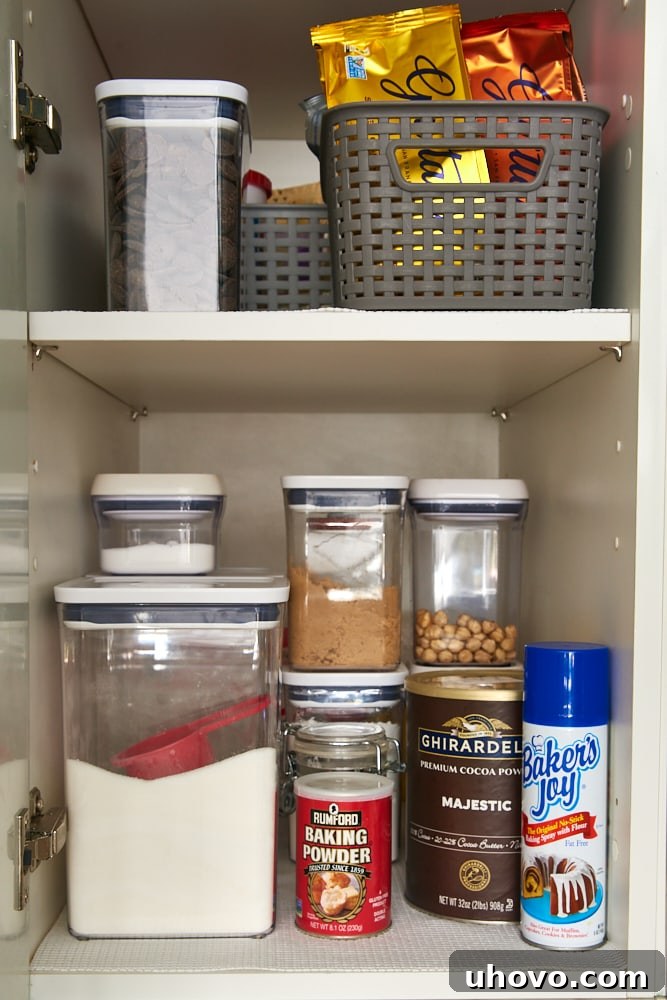
- Airtight Containers: Essential for dry ingredients like flours, sugars, oats, and nuts to keep them fresh and protected from pests.
- Bins and Baskets: Perfect for corralling smaller, irregularly shaped items like chocolate chips, muffin liners, extract bottles, or small cookie cutters. Clear bins allow for quick visual identification.
- Drawer Dividers and Organizers: Keep measuring spoons, cups, spatulas, and whisks neatly separated and easily accessible, preventing a jumbled mess.
- Vertical Dividers: Transform cabinet space by allowing you to store baking sheets, cutting boards, and shallow pans upright, making them easy to grab without toppling stacks.
- Pull-out Shelves or Drawers: Maximize accessibility in deep cabinets, bringing contents to you instead of requiring you to dig around.
- Tiered Spice Racks or Lazy Susans: Ideal for organizing extracts, food colorings, and smaller spice jars, ensuring everything is visible and reachable.
Crucially, before purchasing any storage items, meticulously measure your cabinets, drawers, and pantry shelves. Knowing the exact dimensions will prevent wasted money on ill-fitting products and ensure you select solutions that maximize every inch of your space. While the temptation might be to buy everything beforehand, it’s often more effective to finalize your plan and *then* shop for specific organizational tools to avoid unnecessary purchases.
My Go-To Baking Organization Tools
Every baker’s needs are unique, but I’m happy to share some of my personal favorites that have revolutionized my baking workflow. I am a staunch advocate for airtight containers for most dry ingredients. They not only preserve freshness and prevent spills but also create a uniform, aesthetically pleasing, and highly functional storage system. While I do keep some less frequently used ingredients in their original bags, the clarity and ease of access provided by containers are unparalleled.
For those ingredients that don’t warrant a permanent container, such as extra bags of chocolate chips or specialty flours, I rely on sturdy storage bins. These bins neatly hold zip-top bags and resealable pouches, making it far simpler to grab what I need without rummaging through a stack of loose bags. Bins are also incredibly helpful for accessing items on higher shelves, as you can simply pull the entire bin down. While my bins prioritize function, there’s a vast array of beautiful and stylish options available to match any kitchen aesthetic.
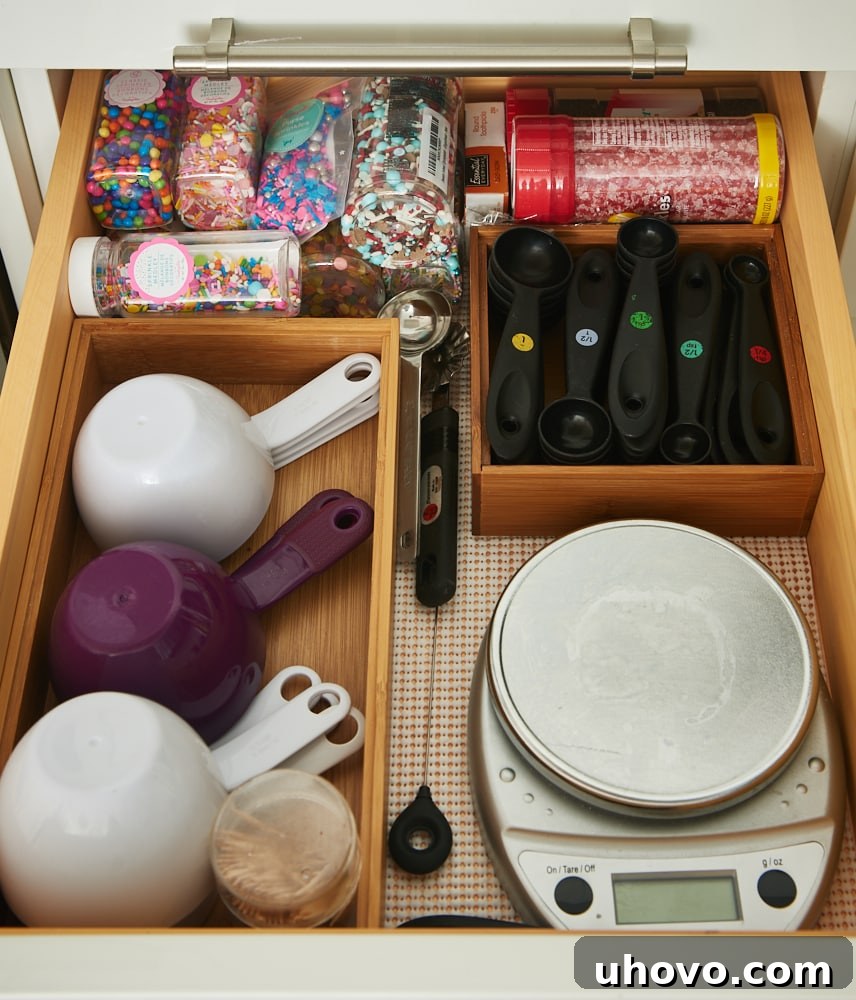
To keep my drawers in order, I use several drawer dividers. These are indispensable for neatly organizing measuring spoons, measuring cups, and other small tools. As someone who bakes frequently, I highly recommend having multiple sets of essential tools. One of the greatest luxuries in my baking setup is having several sets of measuring spoons, sorted by size, ready for use. It truly speeds up the baking process and is one of the most satisfying aspects of my organized kitchen.
Step 6: Methodically Store Your Organized Baking Supplies
Now comes the satisfying part: returning all your carefully sorted items to their designated spots according to your finalized plan! If you’ve acquired new containers, bins, or dividers, this is the time to implement them, adding the final touches to your beautifully organized system.
When transferring ingredients into airtight containers, always keep expiration dates in mind. For high-turnover items like all-purpose flour or granulated sugar, this may not be a major concern. However, for specialty flours, less-used spices, or baking mixes, it’s wise to either write the expiration date directly on a label or keep a running list handy. This prevents waste and ensures the quality of your bakes.
Smaller items, as discussed, thrive in bins or baskets. For instance, I maintain one dedicated bin for frequently used add-ins like various chocolate chips, and another for less common ingredients like specialty nuts or dried fruits. I also have a small, upright bin specifically for extracts, which not only makes them easier to find but also prevents accidental spills and keeps shelves cleaner.
Install any drawer and cabinet organizers, making sure they fit snugly and enhance functionality. If you’ve invested in more elaborate solutions like pull-out shelves for deep cabinets, install them properly now so you can immediately fill them and start reaping their benefits.
Step 7: Strategically Manage Overflow and Utilize All Available Space
Even with the most meticulous organization, you might find that your dedicated baking space simply doesn’t accommodate every single item. If you’ve thoroughly decluttered and are confident that everything you have is essential, it’s time to explore alternative storage solutions for the overflow.
First, maximize less accessible areas within your kitchen. High cabinets, often overlooked, are perfect for storing items you rarely use, such as seasonal bakeware, large specialty appliances (like an ice cream maker), or bulk ingredients. Ensure these items are safely stored and easy to retrieve when needed.
Consider adding a rolling kitchen cart if you have the floor space. These versatile units can provide extra storage for ingredients, tools, or even a small appliance, and can be tucked away when not in use. Many bakers find them invaluable for creating a movable “baking station.” While I prefer to keep most of my essentials within the kitchen, I do store a few infrequently used pans and smaller appliances in a closet in my office, demonstrating that storage doesn’t always have to be confined to the kitchen itself.
Don’t forget the potential of your kitchen counter. While I personally favor a minimalist countertop for ease of cleaning and a sense of calm, I’ve found it incredibly practical to keep my most-used utensils in a decorative crock or holder. My stand mixer, though not used daily, resides permanently on the counter. Its sheer size makes cabinet storage cumbersome, and frankly, it often adds a stylish touch to the kitchen aesthetic.
Step 8: Implement a Labeling System That Works for You
At one point, I went overboard with labeling every single item in my kitchen. While initially satisfying, I quickly realized it was too much to maintain for my personal habits. My only absolute labeling must-have is my spice drawer, where clear labels are essential for quick identification.
For high-volume staples like all-purpose flour and granulated sugar, I typically don’t feel the need to label their containers, as their appearance is distinctive. However, if I’m storing less common flours (like rye or almond flour) or any ingredient that could be easily mistaken for another, those containers absolutely get labeled. The goal is to avoid confusion and ensure accuracy in your baking.
There’s no universal “right” or “wrong” amount of labeling. Your system should be tailored to your preferences and needs. If you find visual cues are enough, that’s perfectly fine. If labels enhance your efficiency and reduce stress, embrace them.
I admire the beautiful kitchens and pantries I see online with perfectly uniform, aesthetically pleasing labels. While visually appealing, this level of detail isn’t where I choose to invest my time. If that resonates with you, go for it! But please don’t feel that elaborate labeling is a prerequisite for an organized and functional baking kitchen.
Your labels can range from a charming chalkboard label with elegant handwriting to a simple piece of tape with a handwritten note. Essentially, there’s a labeling spectrum from purely functional to primarily aesthetic. Find your happy medium on this scale and create a system that genuinely suits your baking style.
Step 9: Establish a Routine for Ongoing Maintenance
The beauty of a well-organized baking space lies not just in its initial setup but in its sustained functionality. You’ll quickly discover that maintaining your organized baking supplies becomes significantly easier when every single item has a designated home. This principle applies equally to small tools, bulk ingredients, and large appliances.
A key benefit of an organized system is having a far clearer understanding of what you have on hand. When items are visible and in their proper place, you can easily assess your inventory, preventing duplicate purchases and ensuring you never run out of a crucial ingredient mid-bake.
Integrate periodic maintenance into your routine. This could involve a quick weekly tidy-up, a monthly check of expiration dates to discard unusable items, and a quarterly deep clean and decluttering session. Some bakers find it helpful to keep a detailed inventory, which can be as simple as a pen-and-paper list or as sophisticated as a digital spreadsheet or a dedicated app. Choose the method that best supports your baking habits.
Enjoy the Rewards of Your Organized Baking Space!
By investing the time and effort into organizing your baking ingredients, pans, and tools, you’re not just tidying up – you’re creating a foundation for more efficient, joyful, and successful baking experiences. A streamlined kitchen allows you to focus on the creative process, rather than the search for misplaced items.
Remember, every kitchen is unique, and every baker’s habits differ. My hope is that these comprehensive tips provide a robust framework for you to tailor your kitchen setup, maximizing your available space and making your personal baking journey smoother, easier, and ultimately, more fulfilling!
Explore my Amazon Storefront for a curated selection of my favorite kitchen organization tools and supplies.
Further Enhance Your Baking Skills
Eager to expand your baking knowledge and refine your techniques? These articles offer excellent starting points for delving deeper into essential baking tools, ingredients, and methods.
- A Baker’s Guide to Sheet Pans
- How to Measure Flour
- How to Soften Butter
- The Creaming Method
- Lined vs Unlined Baking Sheet
- How to Choose Baking Pans
- Light vs Dark Brown Sugar
- How to Make Vanilla Extract
- Guide to Cookie Scoops
Bake or Break is a participant in the Amazon Services LLC Associates Program, an affiliate advertising program designed to provide a means for us to earn fees by linking to Amazon.com and affiliated sites.