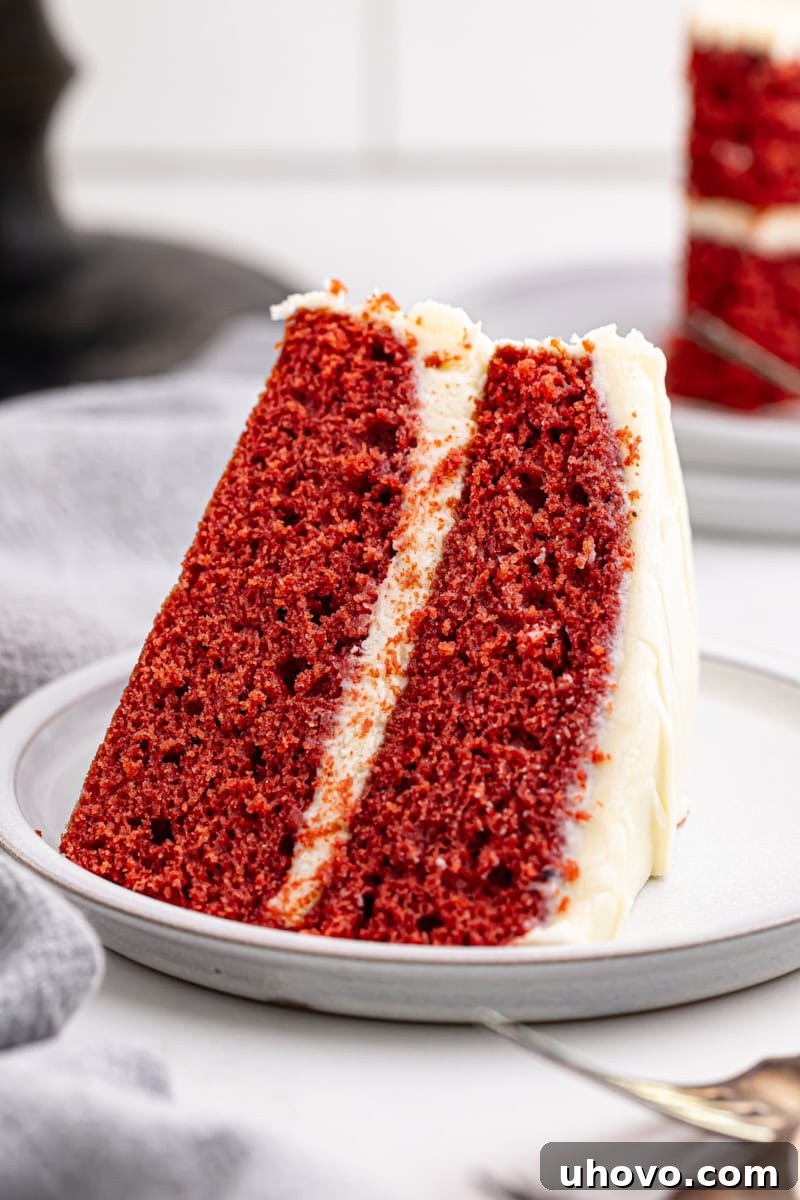
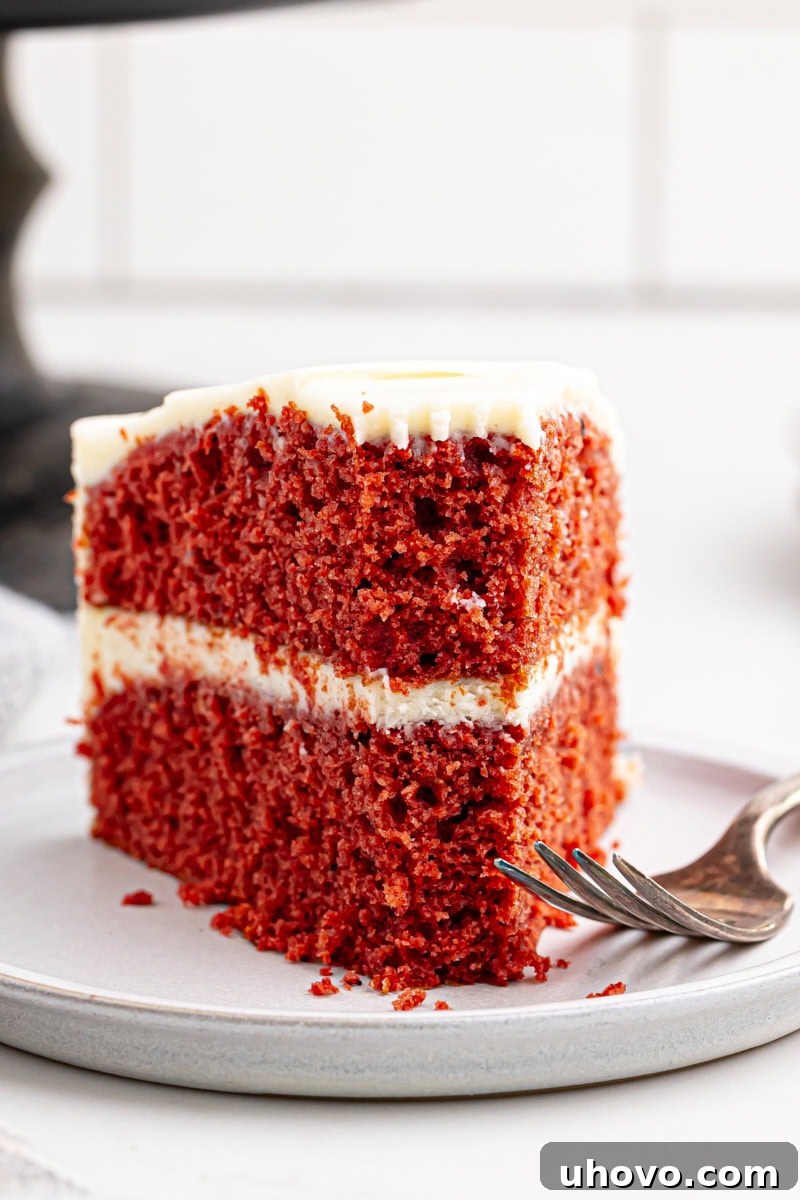
Indulge in the irresistible charm of this magnificent Red Velvet Cake – a true celebration of flavor and texture! Each glorious slice offers a harmonious blend of tangy, sweet, and subtle chocolaty notes, all crowned with the silkiest, most luscious cream cheese frosting. More than just a dessert, this cake is an experience, promising to be the star of any gathering and a delight to every palate.
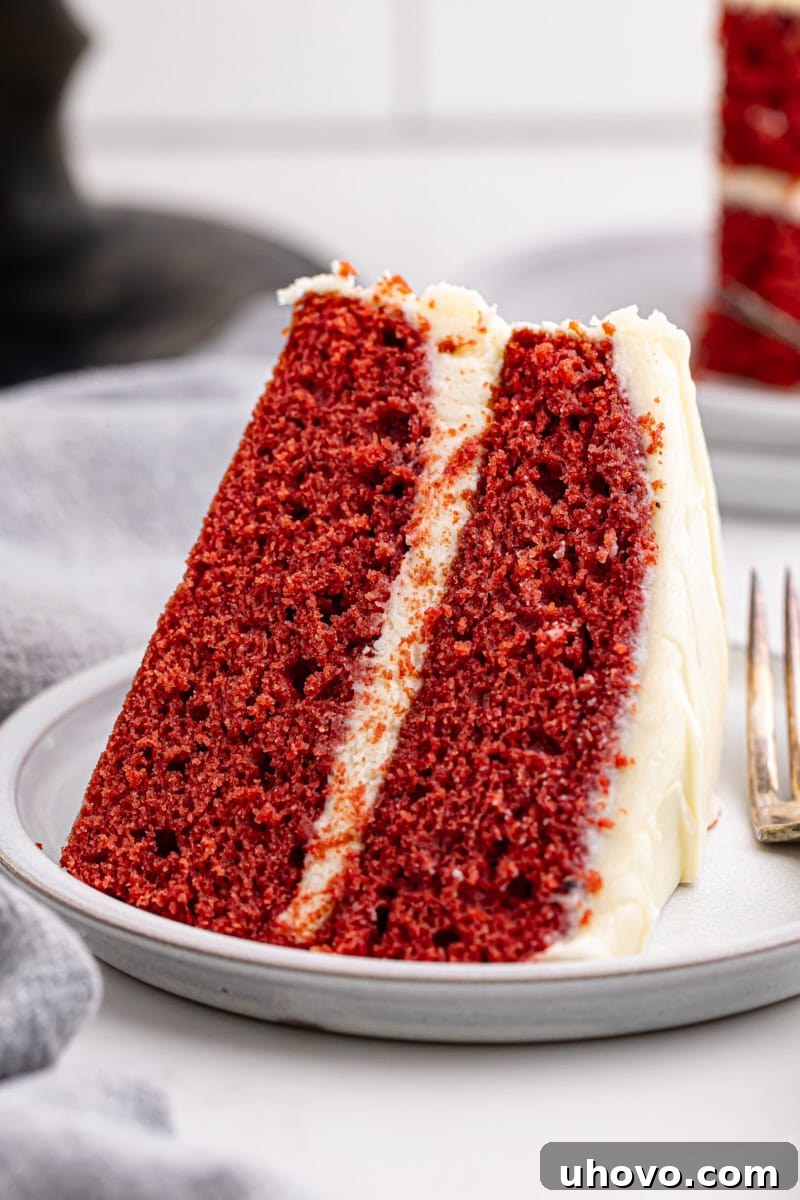
For many, Red Velvet Cake holds a cherished spot in their culinary memories, and it’s easy to see why. Its strikingly vibrant red hue immediately captures attention, while its unmistakable tangy-sweet flavor and exceptionally soft, velvety texture – characterized by a tender crumb and a delightful richness – guarantee it will be a crowd-pleaser on any occasion. This beloved Southern classic, invariably paired with its iconic tangy cream cheese frosting, has transcended regional boundaries to become a universal favorite, synonymous with celebration and comfort.
Whether it’s for a holiday, a birthday, or simply a treat to brighten an ordinary day, a homemade Red Velvet Cake always impresses. While this recipe focuses on a stunning layer cake, if you’re looking for an equally delicious yet simpler, one-pan version that’s fantastic for feeding a larger crowd, be sure to try my Red Velvet Sheet Cake. It offers all the classic flavors with minimal fuss.
Why You’ll Adore This Red Velvet Cake Recipe
This isn’t just another red velvet recipe; it’s a meticulously crafted guide designed to help you achieve bakery-quality results right in your own kitchen. Here’s what makes this particular recipe truly special and why it will quickly become your go-to for this iconic dessert:
- Unrivaled Moisture and Tenderness: Prepare for a cake that literally melts in your mouth with every single bite. The secret lies in a careful balance of ingredients, including the use of vegetable oil, which contributes to an incredibly moist crumb that stays tender for days.
- Exquisitely Balanced Flavor Profile: Forget overly sweet cakes. This recipe strikes the perfect harmony, delivering a subtle hint of rich cocoa that complements, rather than overwhelms, the signature tang from the buttermilk. The result is a sophisticated flavor that’s deeply satisfying without being cloying.
- Effortless, No-Fuss Baking Method: You don’t need to be a seasoned baker to create a masterpiece with this recipe. We’ve streamlined the process to be as straightforward as possible, ensuring that even novice bakers can confidently achieve stunning, professional-looking, and tasting results with ease.
The Rich History Behind Red Velvet Cake
The story of Red Velvet Cake is as captivating as its flavor, dating back to the early 20th century in the American South. Initially, the cake’s distinctive soft texture and subtle reddish-brown hue were not due to food coloring, but rather a natural chemical reaction. The acidic ingredients, such as buttermilk and vinegar, reacted with the anthocyanin pigments present in natural cocoa powder and the baking soda, creating a subtle, reddish tint. This “velvet” texture was a coveted trait in cakes, indicating a fine, smooth crumb.
During the challenging times of the Great Depression, when access to fresh ingredients was limited, companies began to innovate. The Adams Extract company notably played a significant role in popularizing Red Velvet Cake as we know it today. They marketed their red food coloring, suggesting its use to enhance the cake’s color, turning the subtle natural tint into the bold, dramatic crimson that became its hallmark. This strategic promotion helped embed the vibrant red hue into the cake’s identity, transforming it into the iconic dessert we recognize. While both Red Velvet and its close relative, Mahogany Cake, are celebrated classics, each retains its unique appeal, revered for their striking appearance and absolutely irresistible flavors.
Gather Your Essential Ingredients
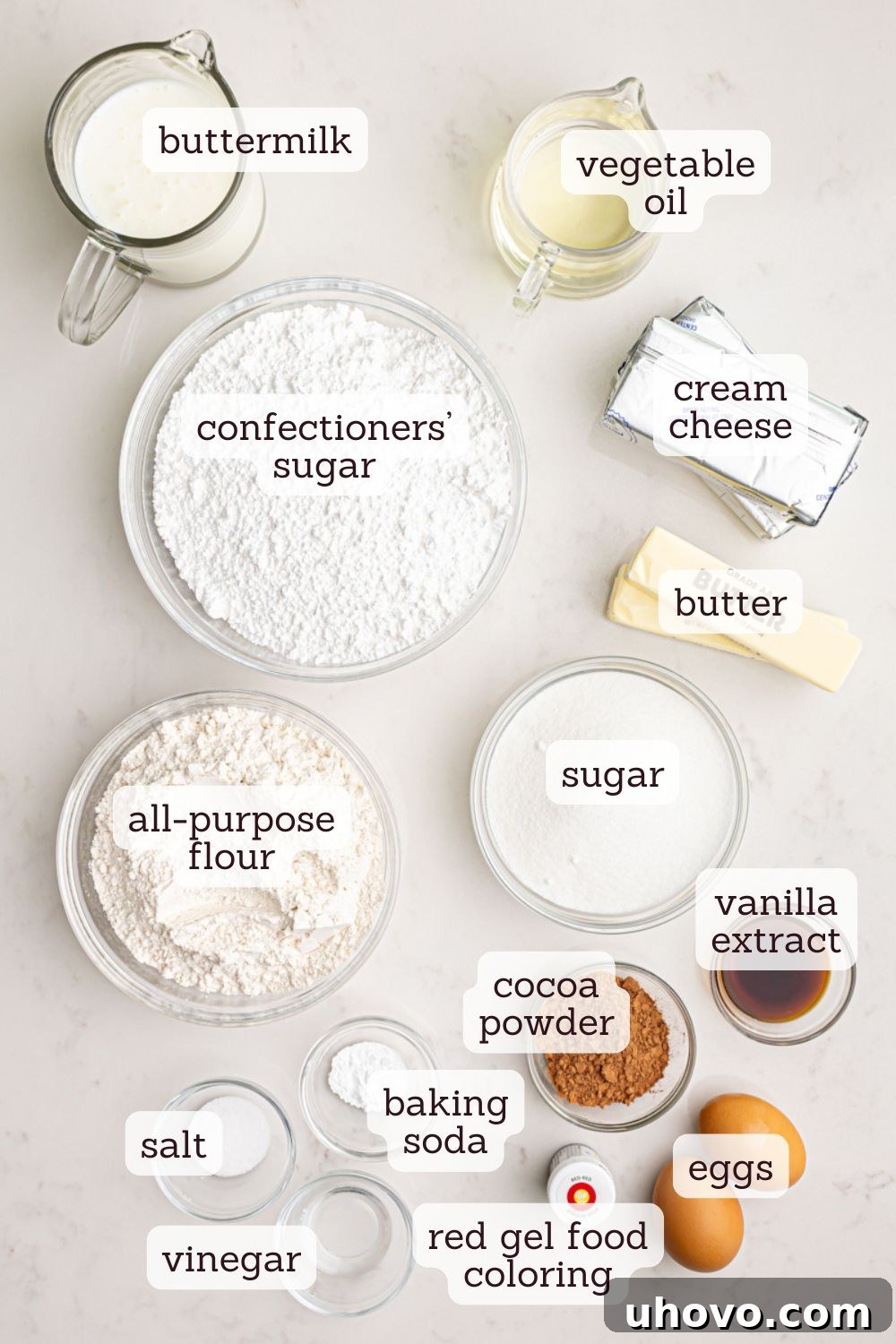
Creating an exceptional Red Velvet Cake begins with selecting the right ingredients. Each component plays a vital role in achieving that perfect balance of flavor, texture, and vibrant color:
- All-purpose flour: The foundation of our cake. Accuracy is paramount in baking, so measure your flour carefully. I highly recommend using a digital kitchen scale for precise weight measurements (300g). If you don’t have a scale, use the “spoon and sweep” method: lightly spoon the flour into your measuring cup until it’s overflowing, then level it off with a straight edge.
- Granulated sugar: Provides essential sweetness and also contributes to the cake’s structure and moisture by attracting and retaining water.
- Baking soda: Our primary leavening agent. When combined with acidic ingredients like buttermilk and vinegar, it produces carbon dioxide bubbles, giving the cake its lift and tender crumb.
- Salt: A crucial flavor enhancer that balances the sweetness and deepens the overall taste profile of the cake. Don’t skip it!
- Unsweetened natural cocoa powder: This is key for the subtle chocolate flavor that defines red velvet. Natural cocoa powder is acidic, reacting with the baking soda to help create the desired crumb and contributing to the traditional red hue when combined with coloring. Avoid Dutch-processed cocoa for this recipe as it’s less acidic.
- Buttermilk: Absolutely essential for Red Velvet Cake’s signature tang, exceptional moisture, and incredibly tender crumb. Its acidity tenderizes the gluten in the flour and reacts with the baking soda for optimal lift.
- Vegetable oil: Unlike butter, vegetable oil remains liquid at room temperature, ensuring the cake stays exceptionally moist and boasts a soft, delicate crumb. It blends seamlessly with other ingredients, creating that characteristic velvety texture.
- Large eggs: These bind the ingredients together, add richness, and contribute to the cake’s structure and rise. For best results, allow your eggs to come to room temperature before mixing, as they incorporate more easily and create a fluffier batter.
- Red gel food coloring: For that iconic, intense crimson color, gel food coloring is highly recommended. It provides a much more vibrant hue than liquid coloring without adding excess moisture to the batter, which could alter the texture.
- White distilled vinegar: Works in conjunction with buttermilk and baking soda to activate the leavening process, contributing to the cake’s lift and distinct flavor profile.
- Vanilla extract: Enhances all the other flavors, adding a warm, aromatic depth that completes the cake’s taste.
- Full-fat cream cheese: The star of our frosting! Ensure it’s softened to room temperature for a smooth, lump-free frosting. Full-fat cream cheese will yield the creamiest, most stable frosting.
- Unsalted butter: Also needs to be softened to room temperature for the frosting. It provides richness and structure to the cream cheese frosting.
- Confectioners’ sugar (powdered sugar or 10X sugar): The sweetener for our frosting. Sift it thoroughly before adding to prevent any lumps, ensuring a silky-smooth finish.
How to Bake Your Perfect Red Velvet Cake
Follow these detailed steps to create a show-stopping Red Velvet Cake that will impress everyone:
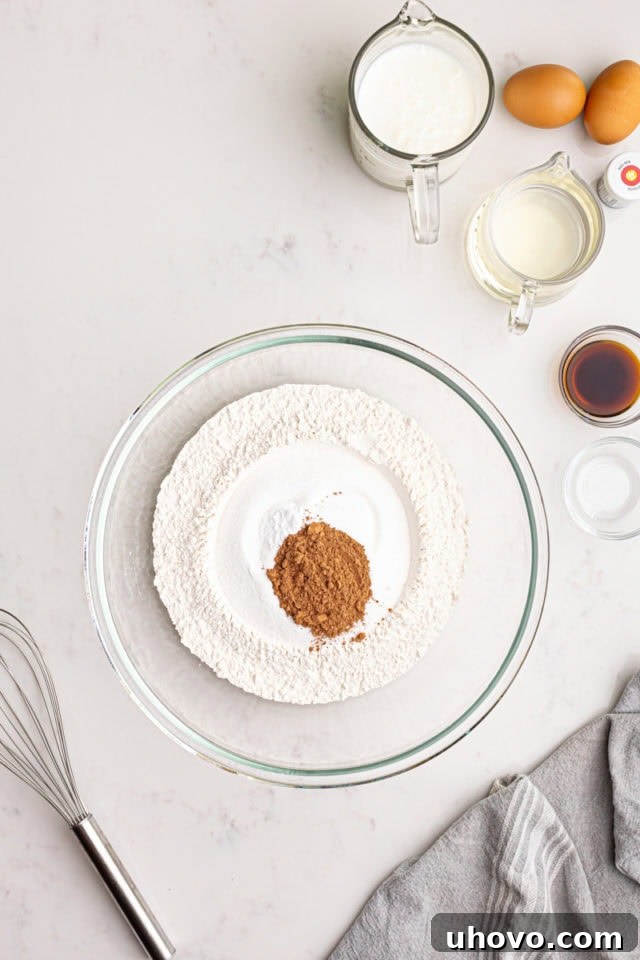
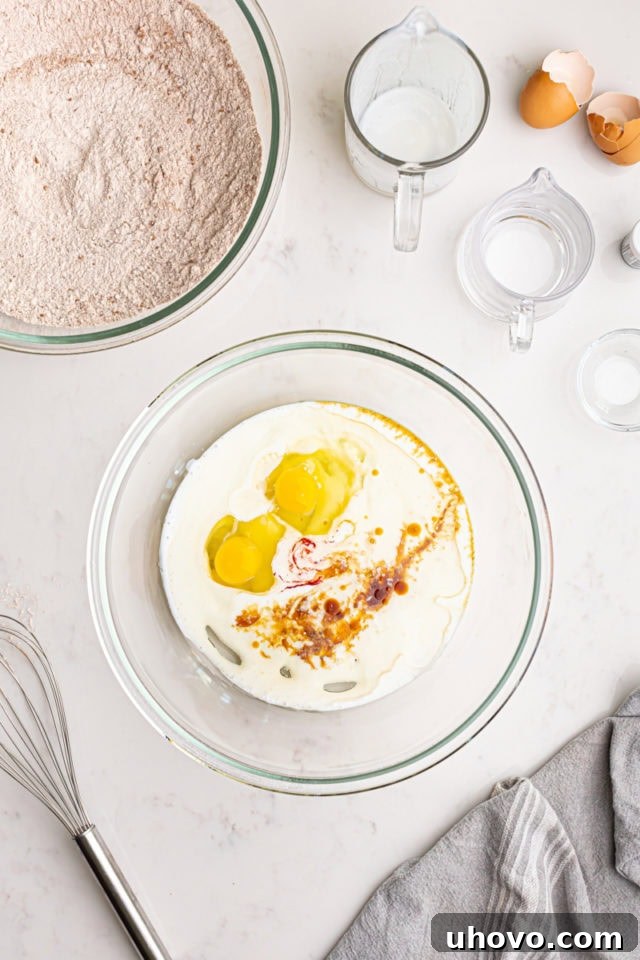
- Prepare for baking: Begin by preheating your oven to 350°F (175°C). Prepare two 9-inch round cake pans by greasing them thoroughly and then dusting them lightly with flour. For extra assurance and easy removal, you can also line the bottoms of the pans with parchment paper circles, greasing the sides of the pan as well.
- Mix dry ingredients: In a medium-sized mixing bowl, combine the all-purpose flour, granulated sugar, baking soda, salt, and cocoa powder. Sift these ingredients together to ensure they are well combined and free of any lumps. Set this bowl aside for a moment.
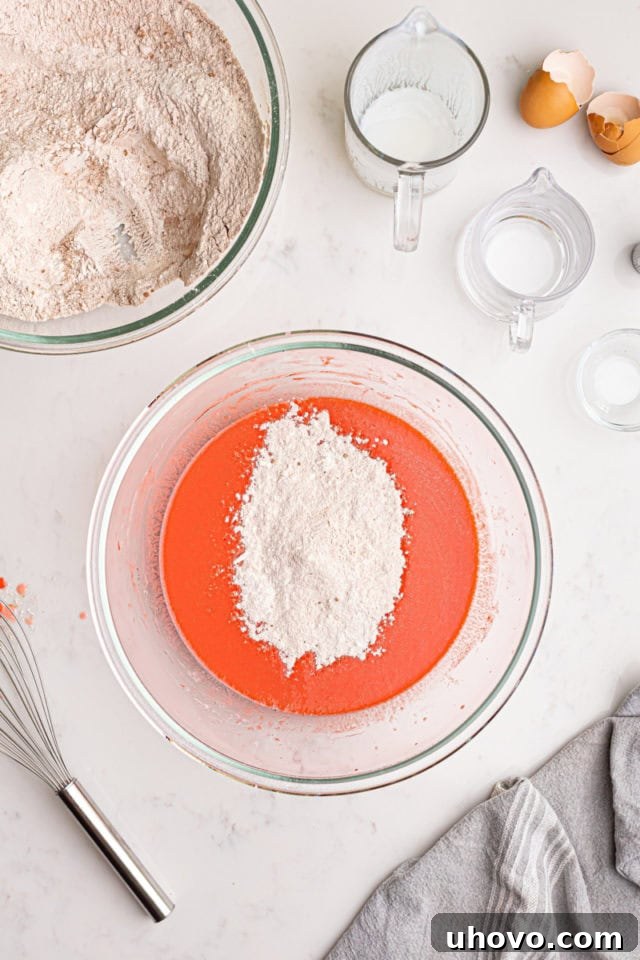
- Mix wet ingredients: In a separate, larger mixing bowl, vigorously whisk together the room-temperature buttermilk, vegetable oil, eggs, vibrant red gel food coloring, white distilled vinegar, and vanilla extract. Whisk until the mixture is completely smooth and uniformly colored.
- Combine mixtures: Gradually add the reserved dry ingredients to the wet mixture in the large bowl. Using a whisk or spatula, mix just until the ingredients are combined and no streaks of flour remain. It’s crucial not to over-mix the batter, as this can lead to a dense, tough cake rather than the desired light, tender crumb.
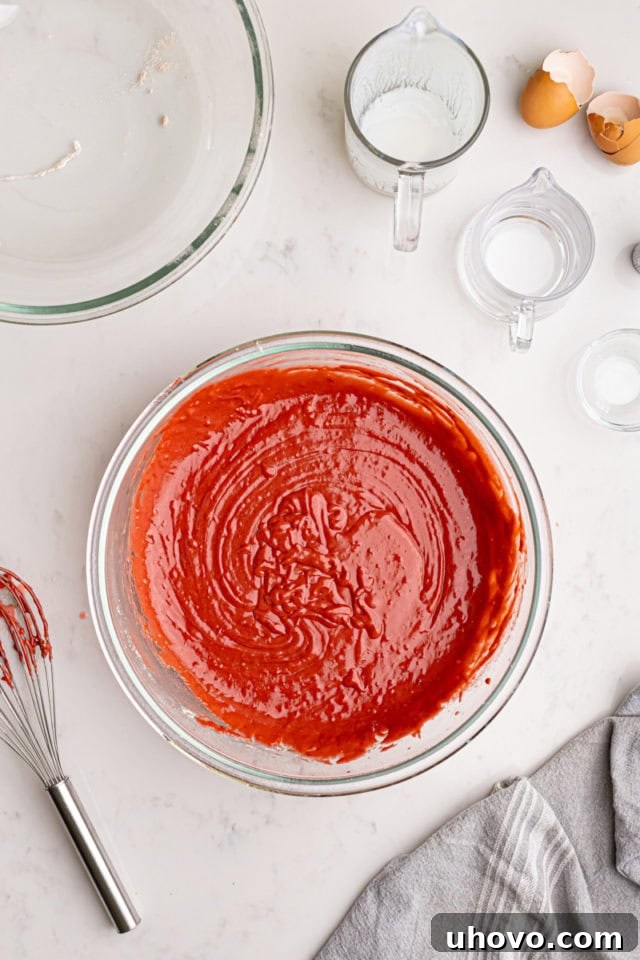
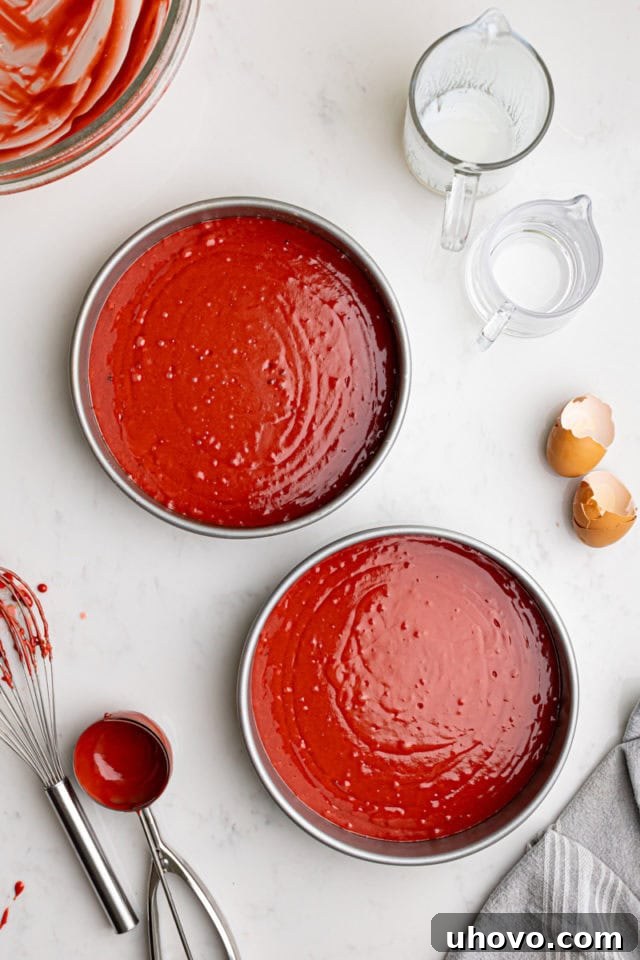
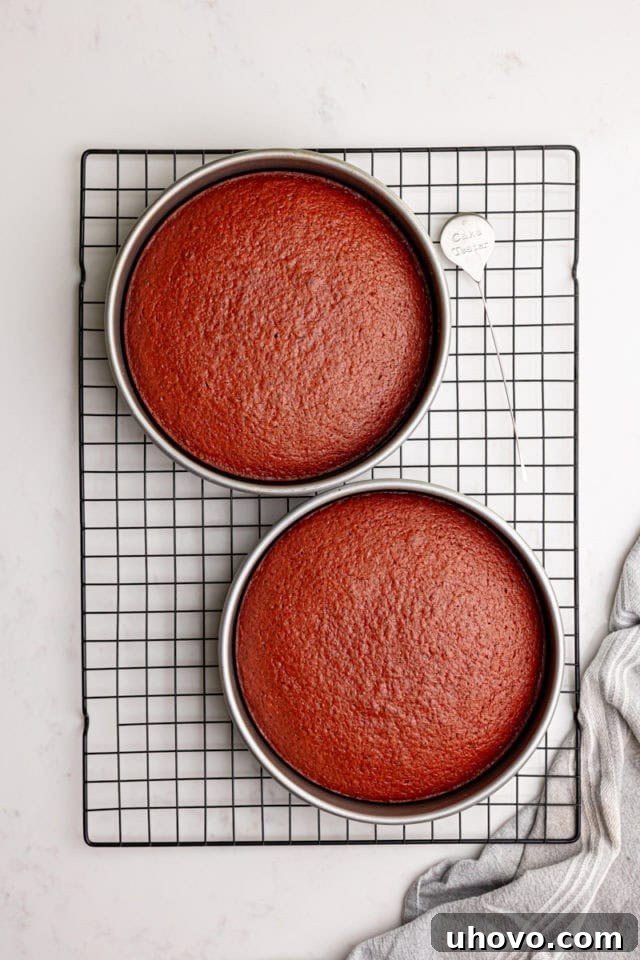
- Bake the cake: Divide the prepared batter as evenly as possible between the two cake pans. For perfectly uniform layers, you can weigh the batter into each pan. Bake for 30-35 minutes, or until a wooden toothpick inserted into the center of a cake layer comes out clean, indicating it’s fully baked.
- Cool the layers: Once baked, remove the cakes from the oven and let them cool in their pans on a wire rack for about 10 minutes. This allows them to firm up slightly. After 10 minutes, carefully invert the cakes onto the wire rack to cool completely. Ensure they are fully cooled before frosting to prevent the frosting from melting.
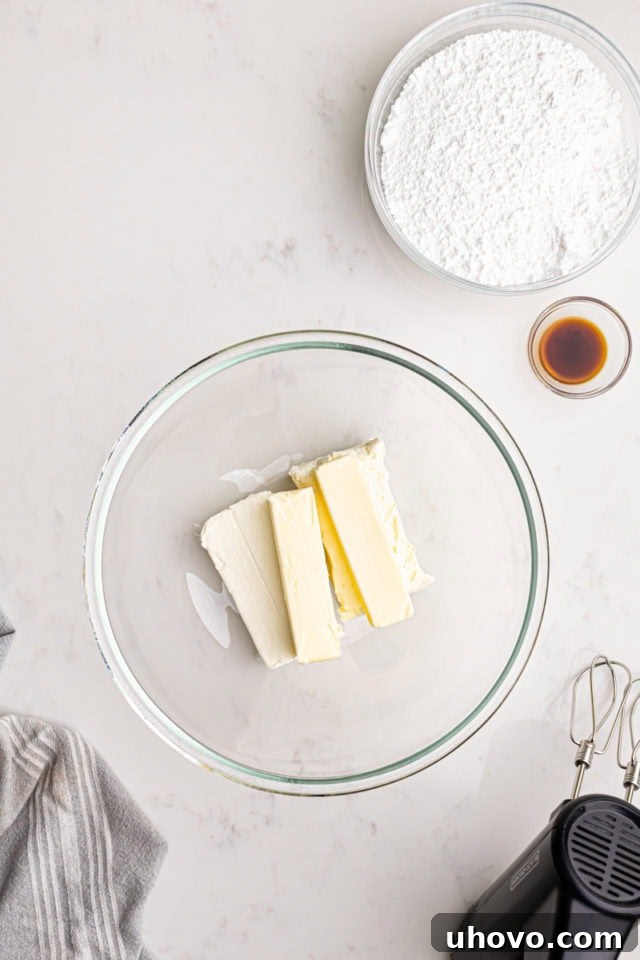
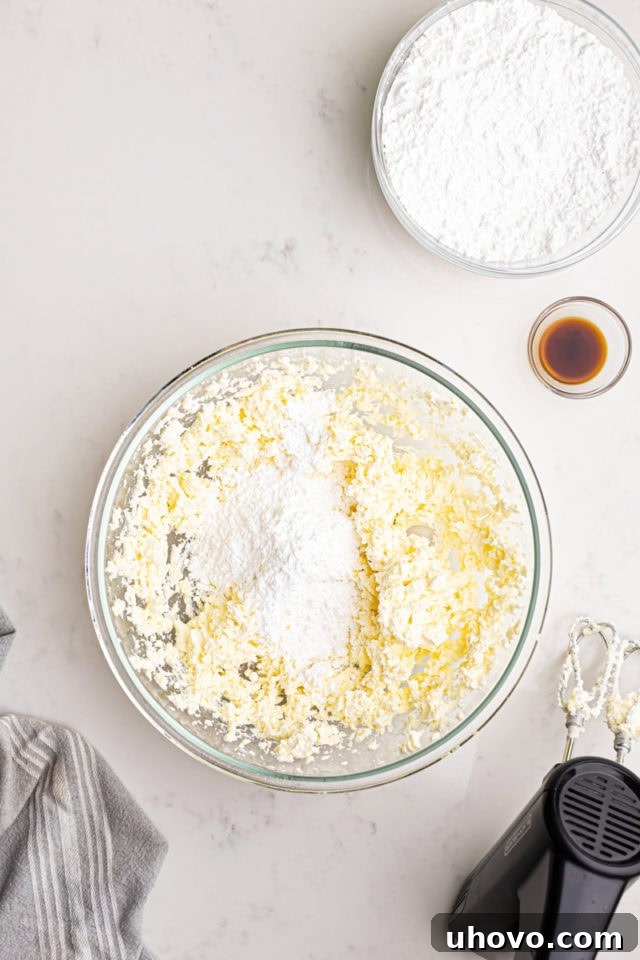
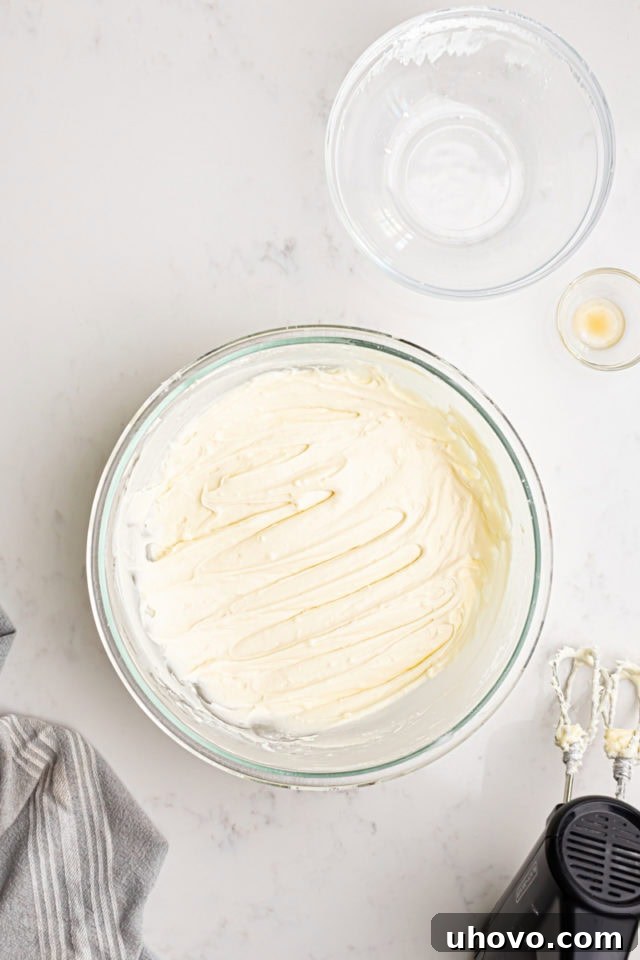
- Make the cream cheese frosting: In a large mixing bowl, using an electric mixer, beat the softened cream cheese and softened unsalted butter together until the mixture is completely smooth and light, about 2-3 minutes. Gradually add the sifted confectioners’ sugar, about 1 cup at a time, mixing on low speed until fully incorporated before increasing the speed. Stir in the vanilla extract and continue to beat until the frosting is wonderfully creamy, light, and easily spreadable.
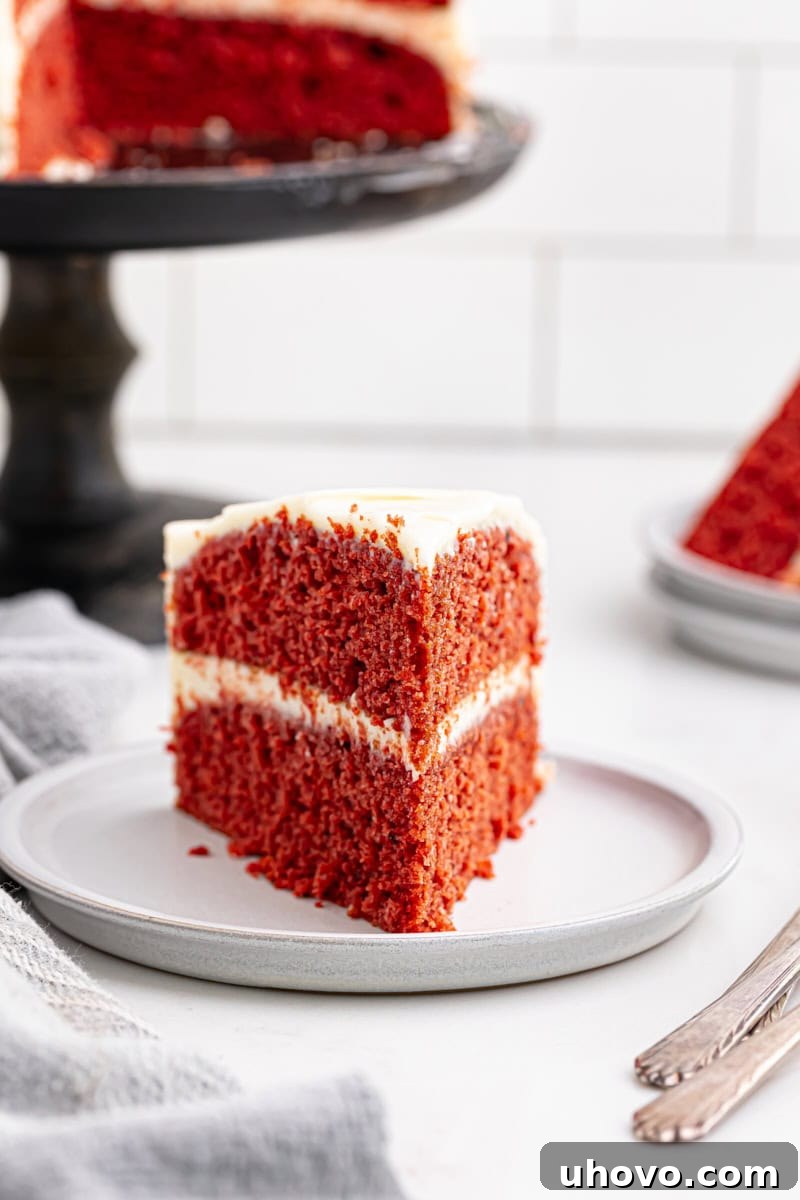
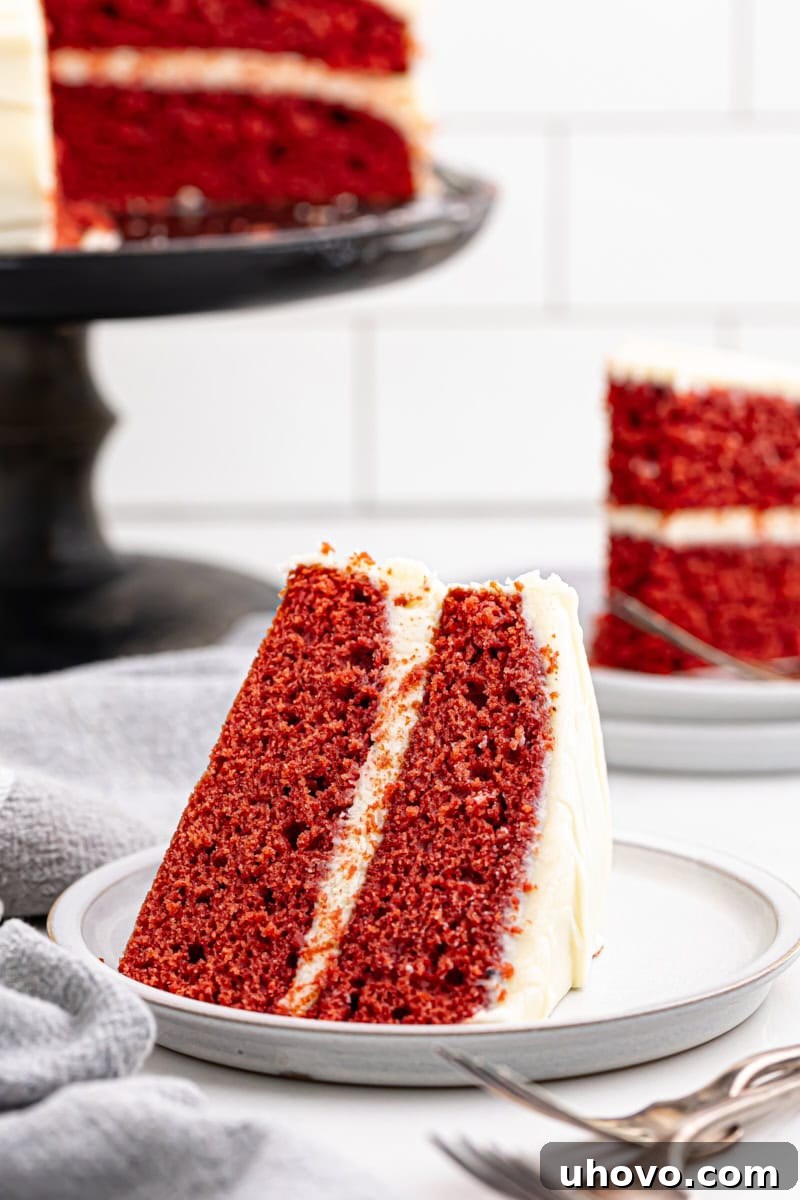
- Assemble the cake: Place one completely cooled cake layer on your chosen serving plate or cake stand. Spread a generous, even layer of the prepared cream cheese frosting over the top of this first cake layer. Carefully place the second cake layer on top. Now, proceed to cover the entire cake – both the top and the sides – with the remaining cream cheese frosting, smoothing it out with an offset spatula for a polished look. Decorate as desired; you can sprinkle crumbled cake pieces on top for a classic finish.
- Chill before serving: For the cleanest slices and to allow the frosting to set beautifully, refrigerate the assembled cake for 20-30 minutes before cutting and serving. This step makes a significant difference in presentation.
Expert Tips for Baking Your Best Red Velvet Cake
Achieving a truly spectacular Red Velvet Cake involves a few key techniques and considerations. Keep these expert tips in mind to ensure your cake turns out perfectly every time:
- Measure accurately: Precision is the cornerstone of successful baking. This is especially true for flour. I cannot stress enough the importance of using a digital kitchen scale to measure ingredients by weight. If a scale isn’t available, make sure to use the “spoon and sweep” method for flour: gently spoon flour into your measuring cup until it’s overfilled, then level it off with a straight edge. Never scoop directly from the bag, as this compacts the flour and results in too much. Learn more about How to Measure Flour for optimal results.
- Choose light-colored, metal pans: The type of baking pan you use significantly impacts the final product. Light-colored metal pans are ideal because they reflect heat evenly, preventing the edges of your cakes from over-browning or becoming dry before the center is fully baked. Darker pans absorb more heat, which can lead to burnt edges.
- Temperature matters: Ensuring your ingredients are at the correct temperature is vital for a smooth, homogenous batter and frosting. All wet ingredients for the cake, such as eggs and buttermilk, should be at room temperature. This allows them to emulsify properly and create a well-mixed, airy batter. Similarly, for the frosting, both cream cheese and butter must be perfectly softened to room temperature. This prevents lumps and ensures a wonderfully creamy, spreadable frosting.
- Avoid over-mixing: Once you combine the wet and dry ingredients, mix just until no streaks of flour are visible. Over-mixing develops the gluten in the flour excessively, which can result in a dense, tough cake rather than the desired light and tender texture.
- Ensure even layers: For a beautifully structured layer cake, aim for equally sized layers. The best way to achieve this is by weighing the batter as you divide it between the pans. If you don’t have a kitchen scale, use a large measuring cup to scoop and divide the batter as evenly as possible.
- Reducing food coloring: While the vibrant red is iconic, if you prefer to use less artificial food coloring, you can certainly experiment. Consider substituting a portion of the gel coloring with natural alternatives like a small amount of beet juice or red fruit puree. Be aware that this might result in a slightly less intense, more brownish-red hue.
- No buttermilk? No problem: Buttermilk is crucial for the classic tangy flavor and tender crumb. However, if you find yourself without it, you can make a quick substitute. Add 1 tablespoon of white vinegar or lemon juice to a liquid measuring cup, then fill the rest of the cup to the 1.5-cup mark with regular milk. Let it sit for 5-10 minutes until it slightly curdles. While this works in a pinch, I always recommend using genuine buttermilk for the authentic taste and texture. Discover more about Buttermilk Substitutes.
- Don’t over-bake: Every oven is unique, and baking times can vary. Begin checking your cakes a few minutes before the recommended bake time. Over-baking is the quickest way to dry out cake layers, sacrificing that desirable moist, velvety texture. A toothpick inserted into the center should come out clean, or with a few moist crumbs attached.
- Level your cakes: If your cake layers bake with a slight dome, you can easily level them for a professional finish. Once completely cooled, use a long, serrated knife to carefully slice off the domed top, creating a flat surface. This step isn’t strictly necessary but greatly enhances the appearance of your finished layer cake. As a bonus, you can crumble these trimmed cake pieces and use them for decoration on top or around the base of the frosted cake.
- Chill the layers for easier frosting: After the cake layers have cooled completely on the wire rack, a fantastic tip for easier handling and frosting is to wrap them tightly in plastic wrap and refrigerate them for about 30 minutes. Chilled layers are firmer, less prone to tearing, and release fewer crumbs into your beautiful frosting.
Exciting Variations to Explore
This classic Red Velvet Cake recipe is incredibly versatile, allowing for delightful adaptations to suit different occasions, preferences, or simply to try something new:
- Red Velvet Cupcakes: Transform this recipe into individual treats! Divide the batter into muffin tins lined with paper cupcake liners, filling each approximately two-thirds full. This recipe yields around 24 standard-sized cupcakes. Adjust the baking time to approximately 18-22 minutes, or until a toothpick inserted into the center comes out clean. Frost with cream cheese frosting once cooled.
- Mini Cakes: For elegant, smaller presentations, this recipe can be baked into three 6-inch cake layers, creating charming mini cakes. If you prefer even thinner layers, consider halving the recipe to yield two thinner 6-inch cakes. Adjust the baking time accordingly, usually around 25-30 minutes, and always check for doneness with a toothpick.
- Alternative Colors: Unleash your creativity by swapping the traditional red food coloring for other hues. Imagine a striking blue velvet cake for a baby shower, a delicate pink for a Valentine’s celebration, or even a vibrant green for a festive holiday. The flavor profile remains the same, but the visual impact is completely transformed!
- Frosting Alternatives: While cream cheese frosting is the definitive pairing for red velvet, there are other delicious options. For a lighter, less tangy experience, try a fluffy stabilized whipped cream frosting. If you prefer a sweeter, more classic finish, a rich vanilla buttercream is an excellent choice. For an authentic, old-fashioned red velvet experience reminiscent of its earliest forms, consider making a velvety ermine frosting (also known as boiled milk frosting).
- Easier Sheet Cake Option: If you crave the quintessential red velvet flavor without the effort of assembling a traditional layer cake, my Red Velvet Sheet Cake is an ideal solution. It’s baked in a single pan, making it incredibly convenient for potlucks, picnics, and casual family gatherings, delivering all the beloved taste with minimal fuss.
Storage Guidelines for Your Red Velvet Cake
Proper storage is key to keeping your delicious Red Velvet Cake fresh and enjoyable for as long as possible. The cream cheese frosting means refrigeration is essential:
- Refrigerator: To maintain its freshness, store your Red Velvet Cake in an airtight container or under a cake dome in the refrigerator. It will stay wonderfully fresh for up to 4 days. For the best flavor and texture experience, allow individual slices to come to room temperature for about 15-30 minutes before serving.
- Freezer: Red Velvet Cake layers freeze exceptionally well, extending their shelf life significantly.
- Unfrosted Layers: If you’re baking ahead, you can freeze the unfrosted cake layers for up to 2 months. Once completely cooled, wrap each layer tightly in several layers of plastic wrap, then an additional layer of aluminum foil. Thaw them overnight in the refrigerator before frosting.
- Frosted Cake: To freeze an entire frosted cake, first place it in the freezer uncovered until the frosting is firm to the touch (this usually takes about 2 hours). Once firm, wrap the entire cake well in plastic wrap, followed by a layer of aluminum foil, or transfer it to an airtight, freezer-safe cake container or resealable bag. Thaw the cake overnight in the refrigerator, then let it come to room temperature for several hours before serving to ensure the cake and frosting are at their ideal consistency.
- Make-ahead tips: Both the cake layers and the cream cheese frosting can be prepared in advance, saving you time on the day of serving.
- Cake Layers: Baked and completely cooled cake layers can be wrapped tightly in plastic wrap and stored at room temperature for 1 day, or refrigerated for up to 3 days.
- Frosting: The cream cheese frosting can be made up to 5 days in advance and stored in an airtight container in the refrigerator. Before use, let it sit at room temperature for about 30-60 minutes to soften, then re-whip it with an electric mixer until it’s smooth and spreadable again.
More Classic Southern Cakes to Savor
Red Velvet Cake
12
servings
25
minutes
30
minutes
30
minutes
1
hour
25
minutes
Pin Recipe
Leave a Review
Ingredients
For the cake:
-
2 ½
cups
(300
g)
all-purpose flour -
1 ½
cups
(300
g)
granulated sugar -
1
teaspoon
baking soda -
1
teaspoon
salt -
1
teaspoon
unsweetened cocoa powder -
1 ½
cups
(360
ml)
buttermilk,
at room temperature -
1 ½
cups
(360
ml)
vegetable oil -
2
large
eggs,
at room temperature -
2
tablespoons
red gel food coloring -
1
teaspoon
white distilled vinegar -
2
teaspoons
vanilla extract
For the cream cheese frosting:
-
16
ounces
(454
g)
cream cheese,
softened -
1
cup
(226
g)
unsalted butter,
softened -
4
cups
(440
g)
confectioners’ sugar,
sifted -
2
teaspoons
vanilla extract
Recommended Products
-
USA Pan Bakeware Round Cake Pan, 9 inch
-
OXO 3 Cup Stainless Steel Sifter
-
Gel Food Coloring
-
Half Sheet Nonstick Cooling Rack
-
Offset Spatula
Instructions
To make the cake:
-
Preheat the oven to 350°F (175°C). Grease and flour two 9-inch round cake pans or line them with parchment paper. If using parchment, cut circles to fit the pans and grease the sides for easy removal.
-
In a medium bowl, sift together the flour, sugar, baking soda, salt, and cocoa powder. Set aside.
-
In a large mixing bowl, whisk the buttermilk, oil, eggs, red food coloring, vinegar, and vanilla extract until smooth.
-
Gradually add the dry ingredients to the wet mixture, whisking just until combined. Be careful not to over-mix.
-
Divide the batter evenly between the prepared pans. Bake for 30-35 minutes, or until a toothpick inserted into the center comes out clean.
-
Let the cakes cool in the pans for 10 minutes before transferring them to a wire rack to cool completely.
To make the frosting and assemble:
-
In a large bowl, beat the cream cheese and butter together with an electric mixer until smooth and fluffy.
-
Gradually add the confectioners’ sugar, 1 cup at a time, while mixing on low speed. Add vanilla extract and beat until the frosting is creamy and spreadable.
-
Place one cake layer on a serving plate. Spread a generous layer of frosting on top. Add the second layer and cover the entire cake with frosting.
-
Smooth the frosting with a spatula and decorate as desired—sprinkling cake crumbs or piping frosting on top.
-
Refrigerate the cake for 20-30 minutes before slicing for clean cuts.
Notes
- Store in an airtight container in the refrigerator up to 4 days.
- For tips, step-by-step photos, and extra details, be sure to read the full post above before starting. It’s packed with helpful info to answer common questions!
Jennifer McHenry
cakes
American
Show off your baking masterpiece!
Snap a pic, tag
@bakeorbreak, and use
#bakeorbreak on Instagram. Can’t wait to see your creation!